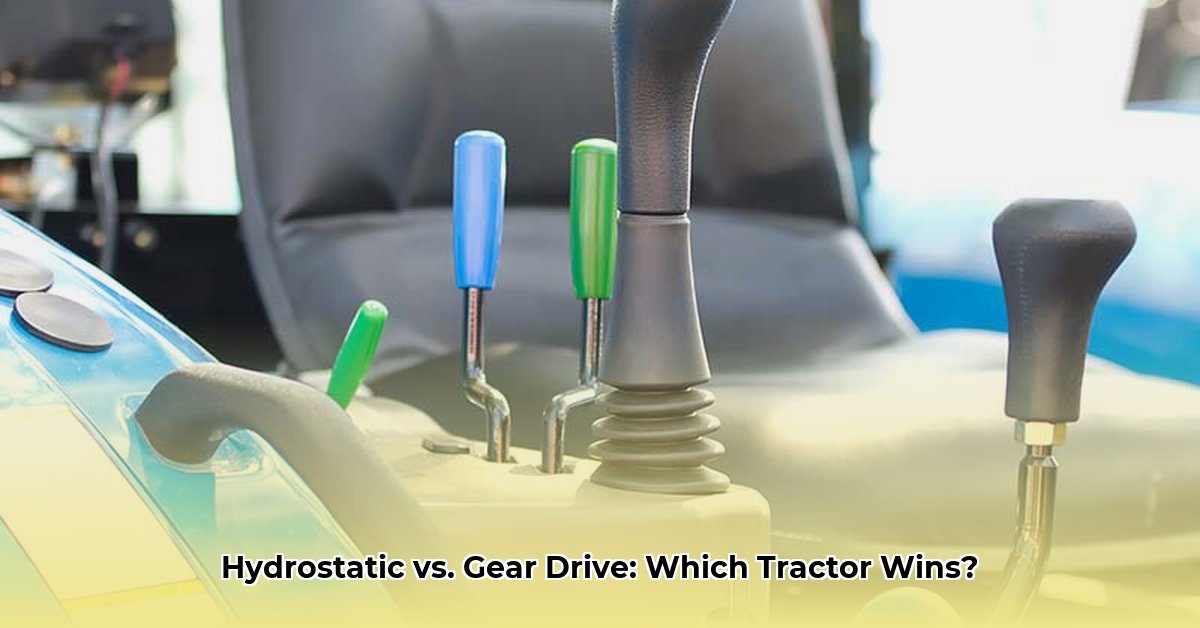
Choosing the right tractor transmission is a critical decision impacting ease of use, operational efficiency, and long-term costs. This guide compares hydrostatic (HST) and gear drive transmissions to help you make an informed choice. For more on tractor types, see this helpful guide: Tractor Types.
Understanding Hydrostatic Transmissions (HST)
Hydrostatic transmissions use hydraulic fluid to transfer power, providing infinitely variable speeds controlled by a single lever. This eliminates the need for a clutch and offers smooth, seamless speed adjustments. Think of it like a highly refined automatic transmission.
Pros of HST Transmissions:
- Effortless Operation: HST simplifies tractor operation, particularly for tasks requiring precise control, like using a front-end loader. This is beneficial for farmers of all skill levels.
- Smooth Speed Adjustments: Enjoy seamless speed transitions, enhancing comfort and efficiency. No more jerky shifts!
- Intuitive Controls: The simple controls are easy to learn, making HST tractors ideal for beginners.
Cons of HST Transmissions:
- Reduced Efficiency at High Loads: HST transmissions may be less fuel-efficient than gear drives under heavy loads or when using the power take-off (PTO) (the system that powers implements). Do you frequently operate under heavy loads? This could be a major factor.
- Maintenance Complexity: HST systems can require more complex and potentially costly maintenance compared to gear drives. Regular maintenance is crucial to mitigate this.
- Less Optimal for Heavy PTO Work: For continuous PTO-driven operations (e.g., hay baling), gear drives generally offer superior efficiency.
Understanding Gear Drive Transmissions
Gear drive transmissions use gears to mechanically transfer power from the engine to the wheels. This is similar to a manual car transmission but typically with many more gears for greater versatility.
Pros of Gear Drive Transmissions:
- High PTO Efficiency: Gear drives excel at powering PTO equipment, offering greater efficiency and reducing stress on implements. How much PTO work do you anticipate? This is a key question.
- Durability and Robustness: Known for their ruggedness and reliability, gear drives are suitable for demanding conditions and heavy use. Are you working in harsh conditions? A gear drive's durability might be crucial.
- Precise Speed Control on Inclines: The stepped gear ratios allow for precise speed control on slopes, improving traction and control.
Cons of Gear Drive Transmissions:
- Steeper Learning Curve: Operating a gear drive requires skill and practice to master efficient gear shifting. Are you experienced with manual transmissions? This will influence your choice.
- Jerky Shifts (if improperly operated): Inaccurate gear shifting can lead to jerky movements, impacting both comfort and efficiency.
- Less Suitable for Frequent Speed Changes: While efficient for sustained tasks, frequent shifting with a gear drive can be disruptive.
Choosing the Right Tractor Gear for You
The optimal transmission type depends on your specific needs and operational priorities. Consider these factors:
Typical Work: Frequent loader work and precise control favor HST. Continuous PTO operation favors gear drive. What are your primary tasks? This is your most important consideration.
Farm Size: Smaller farms may prioritize HST's ease of use, while larger farms might benefit from the efficiency of gear drives.
Terrain: Hilly terrains often benefit from the precise control of gear drives.
Budget: HST tractors typically have a higher initial purchase price.
Experience Level: Beginners might find HST easier to learn, while experienced operators might appreciate the control of a gear drive.
A Simplified Comparison Table
| Feature | Hydrostatic (HST) | Gear Drive |
|---|---|---|
| Ease of Use | Very Easy | More Complex |
| Efficiency | Lower at high loads | Generally higher, especially with PTO work |
| Speed Control | Continuous, smooth | Stepped, precise |
| Maintenance | Potentially more complex and costly | Generally less complex and less costly |
| Ideal Applications | Loader work, frequent stops/starts | PTO-intensive tasks, hilly terrain |
Making Your Decision: Finding the Perfect Tractor
The best transmission is the one best suited to your operation. Carefully consider the pros and cons of both HST and gear drive systems. Research specific models and seek advice from experienced farmers and equipment dealers. This thorough approach ensures you choose a tractor maximizing your productivity and longevity.
Comparing Hydrostatic vs. Gear Drive Tractor Transmission Efficiency for PTO Applications: Key Takeaways
- Ease of Use vs. Efficiency: HST prioritizes ease of use and precise control; gear drive prioritizes efficiency, particularly for PTO work. Which is more important to you?
- Long-Term Costs: Factor in fuel consumption, maintenance, and repair costs when comparing total cost of ownership.
- Sustainable Practices: For environmentally conscious farming, maximizing fuel efficiency is critical. Gear drives often lead to lower fuel consumption.
- Task-Specific Needs: The ideal transmission directly depends on the specific demands of your operations.
This guide provides a foundation for making an informed decision. Remember to prioritize your specific needs and conduct thorough research before making your purchase.